
On March 18, 2010, a 17-year-old boy felt lost, sweating indefinitely under mid 60-degree weather in his room in Northampton, Pennsylvania.
The boy was trying to do a final edit on his first ever newspaper for his high school. From the start to the finish, he did it all by himself: He tried to write, interview, photograph, design and edit. He needed to send the final version to the school’s principal by 10 p.m. It was already past 9 p.m., and the clock continued ticking, against his will.
Born and raised in South Korea, English writing wasn’t his talent, yet. He, however, still wanted to use some fancy words, with the help of Merriam-Webster dictionary. He wanted to use a word he recently learned from a New York Times story. The word was ‘capricious.’ Very fancy word that the author of this memoir still needs to go back to an online dictionary to learn a right usage of it.
“After the girl’s game, the boy’s team appeared on the court to beat the UBCH boy’s team’s butt and the boys really did their job after about 1.5 hours.
“The game was so capricious,” an excerpt from the newspaper, Cougar Chronicle read.
Was it a right usage? Likely not. Nonetheless, the young boy was much thrilled. He felt as if he were writing like a New York Times journalist. Well, of course, he was in his own illusion.

That boy’s name is Sean Na, who is myself, the author of this memoir. (Pardon me if I am referring myself as a third person; it’s a habit Sean’s developed as he’s been overly exposed to news writing for years.)
When I first landed my feet in the U.S., I was 16. Now, I am 25. A memoir by a 25-year-old whose lifeclock hasn’t even passed 9 a.m. may read, “What the heck?” Yes, I agree. But please bear with me, if you will. Sean Na just wants to reflect on his life in the U.S., how this country has trained him to be a better journalist — before he forgets it all.
I’ve come to the U.S. in 2008 to primarily learn how to speak and write in English. I still recall the first English sentence, or more likely a broken clause, that Sean spoke on the date he landed in Indianapolis International Airport on Aug. 30 of the same year.
“How they are?” 16-year-old Sean said to his American host family. Well, he actually meant to say, “How are you?”
Embarassed. Sweating. Confused.
Sean was worried. He wanted to come to the U.S. to ultimately learn a better journalism and hopefully become a better journalist who writes stories in English. It’s been his goal since the moment he entered the land of free press that he would become a better journalist who abridges the gap between the people and the government in the U.S. But with his English language level at the time, he wasn’t sure whether it would be doable.
During my first six months in the U.S., I struggled to enunciate words, like government, student, christianity and many more. Sean often had to spell these words out for the listeners’ sake. English pronunciation could get better (though many folks around me still don’t catch whenever I try to pronounce the word, zoo). When it comes to writing in English, however, Sean didn’t know where to start.
He went straight ahead. He bought an inch-thick notebook, started subscribing to The Lafayette Journal & Courier, The Indianapolis Star and The New York Times, scraped whichever story seemed easier to consume on the notebook and wrote a critique about it.
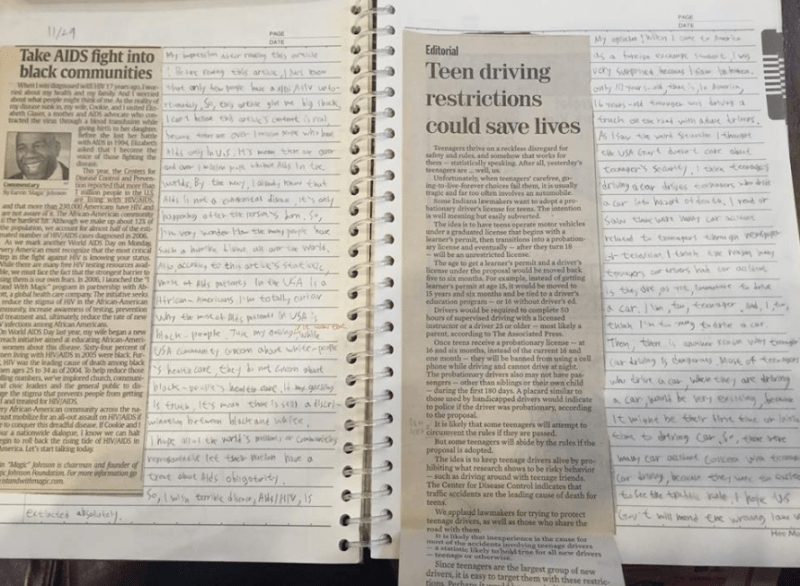
I wrote, wrote and wrote, almost every day during my first year in the U.S. No one ever read what I wrote, but myself. Did Sean write grammatically correct? Oh no. He didn’t care about grammar. More likely, he just did know so little about English grammar at the time.
He fearlessly wrote whichever way he liked to write. A simple instruction for a clumsy, teenage writer.
A few years after, it was a college application season. I wanted to go to a decent journalism school. But Sean had no clues which school had a good journalism program. Yes, he needed to borrow the Google’s (maybe) reliable search engine to get ‘some’ clues.
“What’s a decent journalism school in the U.S.?” 18-year-old Sean Na typed on the Google’s search box. “The Missouri School of Journalism,” the Google answered him.
“Missouri? Is it a state?” Sean mumbled seconds after he saw the search result. But he trusted the almighty Google. In fact, he only had applied for the MU journalism school until his high school adviser scolded him and said, “Sean, you are crazy. Just one school? That’s no no.”
Thanks to Santa Clause, I got accepted into the MU journalism school two days before the 2010 Christmas Eve.

The Google said the MU journalism school is one of the best journalism schools in the U.S. I believed it. Sean Na may have believed it too much, thinking as if he already became a competent journalist just because he’d soon be a journalism student at MU.
Sept. 30, 2011. That’s the date Sean’s first story for The Maneater, MU’s campus newspaper, was published. It was an about 500-word story, and no single sentence survived through a wild edit. Yes, the story was completely re-written.
Sean was the only student reporter whose primary language wasn’t English at the time. But, that didn’t stop him. He kept rolling, regardless.
By the end of his freshman year at MU, he published 26 stories via The Maneater. He was still much reliant on a wild edit. But, he didn’t always appreciate it, especially for his last story of his freshman year.
The story was about covering a senior sendoff. I sent a 600-word story to my editor, but it was published with fewer than 350 words. Sean wasn’t happy and wrote probably the most rebellious comment that he shouldn’t have done for a story under his byline.
Sean wrote: “This is not my story. It got second-handed by somebody.”

That somebody is now my good friend, who’s contributing greatness to America through his hard-worked reporting.
After the freshman year, Sean spent about three years in South Korea for military service and internship at The Associated Press.
When returned to MU in January 2015, he became a much proud (in a bad way) 22-year-old, as he thought he must have become a way better writer than most of MU journalism students simply because he interned at the AP.
Well, he absolutely misjudged himself.
But he didn’t realize until summer of 2016. For nearly 11/2 years, he only cared about a number of stories running under his byline. He didn’t care much about sentence flow, style and grammar, but did care much about simply filling up the words. The rest of refinery process went to his editor.
That was wrong. So wrong. My goodness.
Before Summer of 2016, Sean Na, once much self-absorbed journalist, ran more than 50 stories under his byline. However, hardly any of those stories went online without an extensive refinery process.
July 13, 2016. The date I would never forget. It was the date Sean Na finally realized he had been a much arrogant journalist. It was the date Sean Na finally overcame with his AP (Associated Press) fantasy. It was the date Sean Na truly learned about precision journalism.
And, it was the date Sean Na thankfully received a wake-up call that has shaped him a better journalist by far.
At the time, Sean Na was an intern for Bloomberg BNA based in Arlington, Virginia. I sent my final product to my boss, who was a managing editor.
About an hour after, he called me into a conference room. I was, frankly speaking, expecting some compliments, as I spent much time writing a 800-word story with some, good data.
He and I sat in the conference room. He, for a while, didn’t say anything. I nervously asked, “Mike, is there a problem?”
“It needs some work,” he replied, while handing me a copy of the story.
On a white piece of paper, I saw too many red marks. It apparently didn’t need some work, but a lot of work.
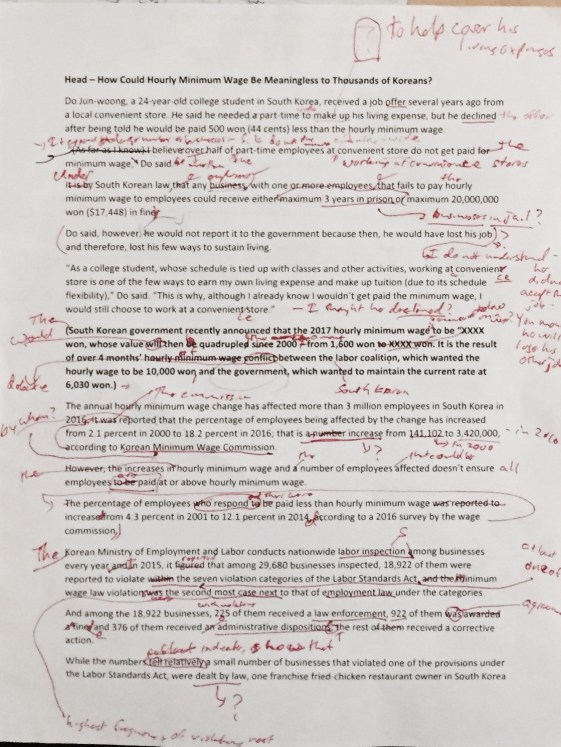
He said: “Sean, you need a lot of practice in English writing. You are not on a level of becoming a journalist in the U.S. You will need to fix your English language, unless you intend to go back to Korea and write stories in Korean.”
He emphasized precision journalism, a very duty that every journalist must pursue.
I was shocked, embarrassed and ashamed. For few minutes, I didn’t say a word. In fact, I didn’t know what to say.
The story went through a two-week long of refinery process. It was shorten to 550 words. Most of words Sean initially wrote were taken away.
That wake-up call. Sean didn’t enjoy it firsthand. Had Sean Na, once an arrogant journalist, not received that call, he would have remained self-absorbed in himself, even now.
But most importantly, you may have been having a hard time scrolling down this memoir.
Sean Na is writing this long, dried words to you 9:22 p.m., Sept. 24, 2017, in his room in Columbia, Missouri. After about 11 hours, he will be leaving this land of free press and return to his motherland, South Korea.
Sean has undeservedly learned unpriceable lessons from many heartwarming reporters, editors, professors and friends he’s mingled with for the past nine years of his times here. Their loves, cares, guidances and thoughts, Sean shall never forget.
He didn’t and still doesn’t want to leave this country. He admires a respectful newsroom culture here. He admires how many hard-working journalists here are working to hold the powerful accountable and become a channel for underrepresented people to voice their grievances and be represented.
Maybe a different place outside the U.S. needs Sean Na’s persistent reporting.
It’s been a great time. It’s been a great honor. Folks.
Until we see again.
Rock ‘n roll.
-Sean Na-

 Journalism Blog By Sean Na