
NORYANGJIN, SEOUL – Noryangjin Goshichon, or “Exam Village,” is a land of hope. It is a congested, dull neighborhood in a middle of Seoul where its residents hope they could get out as soon as possible, hopefully with an outcome.
Located just south of Han River, it is a place that break times are discouraged, even during the holidays.
Rather, it is a place that rolls 24/7.
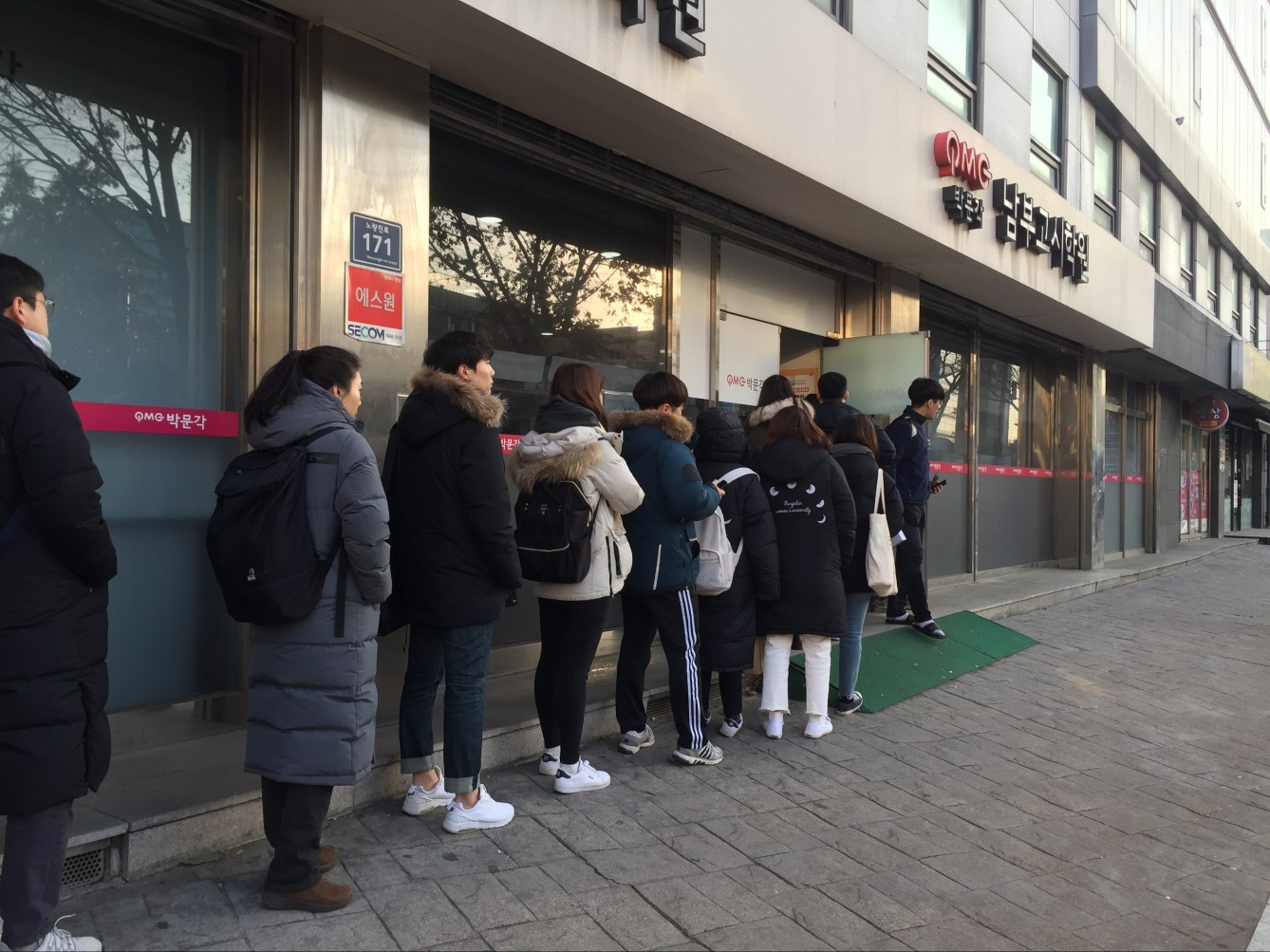
Hundreds of South Korean young men and women are waiting in lines at Nambu Qualification Exam Institution to get a class enrollment pass 9 a.m. in Noryangjin, Seoul, on Jan 1. 2018. Photo Credit: Sean Na
On a Monday morning under a biting windchill, hundreds of young men and women, with full backpacks or some with luggages, hustled themselves into Nambu Qualification Exam Institution near the Noryangjin subway station.
It was few hours after the first sunrise in 2018. But a new year’s day didn’t come anything special to them. They needed to get limited class enrollment passes to get ahead of others who will take the same exam in 16 days.
Shin Ha-rim, 25, was one of them waiting in layers of lines inside the institution building.
The 2018 marked her third year living in Goshichon, but she said she wouldn’t mind living here because it’s been her dream to be a civil servant and Goshichon is one of best places to fulfill her dream. However, she said, there are many others who come here for the same goal, but with a different mindset unlike Shin’s.
“It’s not that they want (to be a civil servant),” she said. “But many of them reluctantly choose to be here, as they neither go to one of prestigious colleges in Seoul, have a rich parents who could support their dreams nor have a personal connection with hiring officials at major companies, like Samsung, who would hire them.”
“It’s a bitter life,” she said.
Easiest path to a life without worries
South Korean civil servant is categorized in nine grades. And many residents in Goshichon prepare for grade 9 civil servant, which gets paid below the monthly minimum wage during the first year.
However, once a person becomes a civil servant, he or she is guaranteed, unless commits a felony, for lifetime employment by a South Korean law.
That may be the rarest merit in the South Korean job market, in which a notion of lifetime workplace has ceased to exist after the 1997 Korean Financial Crisis, said Joo Sung-soo, professor at the Graduate School of Public Policy at Hanyang University.
“Ever since the 1997 IMF Crisis, South Korean youths have begun to fear of working at a company where employee restructuring is frequently executed,” Joo said.
That fear, Joo said, could explain why more and more South Korean youths begin to seek a government job.
In fact, as of May 2017, nearly twice many of South Koreans aged 15 to 29 were pursuing government jobs instead of pursuing jobs at private companies, according to a 2017 statistics by the Korean Statistical Information Service (the KOSIS).
Heo Hee-joo, 25, who’s been living in Goshichon for 10 months, said she never considers working at a private company.
Heo holds a sociology degree at Kookmin University, one of U.S.News’ globally ranked schools in South Korea. But she didn’t think of any other career paths but a civil servant, she said, because of a fear of losing a job at an age she’s supposed to be an active worker.
When asked what was her childhood dream, Heo said she didn’t have any. When asked again why she chose to study sociology in college, she said it was the best department she could go with her college examination test score.
And when asked for last time why she wants to work for the government, she said:
“Because I want to be happy and I don’t want to be laid off unexpectedly.”
An old education, an old culture
Toward the end of interview on a busy street in Goshichon, Heo said part of blame why she could only think of becoming a civil servant should be attributed to the Korean education system.
“My country doesn’t give a chance for us to explore our careers while in school,” she said. “I literally studied, studied and studied. I was rather being injected with knowledges that I must know to score higher on an exam.”
In South Korea, it is not unusual to spot teenagers in school’s uniforms roaming around the streets surrounded by private academies close to midnight. Most of these academies help students get a better grade in school.
On average, a Korean high school student studies about 7.6 hours a day, which excludes hours spent in school, according to a 2014 statistics by the KOSIS. Meanwhile, nearly half of high school students surveyed in 2016 by the KOSIS said they weren’t sure of what they would be asked to do if they get a desired job.
“That was all I learned from schools — learn to score higher on an exam,” Heo said.
It came near a lunch time. Goshichon’s residents went out on the streets and started to seek for a cheaper place to eat.
Cheaper food expenses well represents the Goshichon, a unique culture designed for those hopeful South Koreans, many of whom live off by their parents’ pocket money.
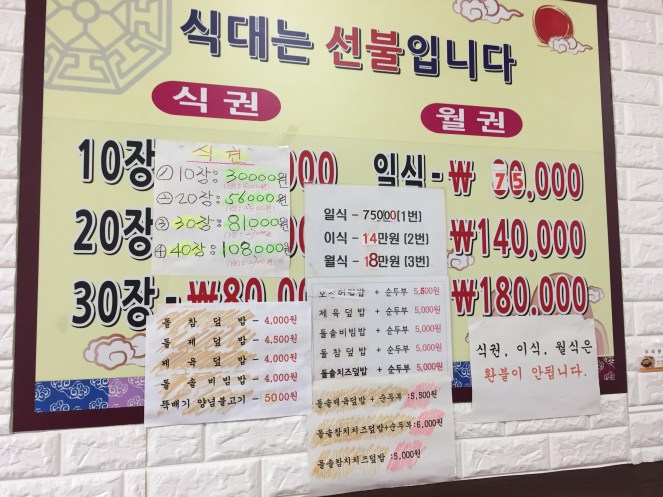
At many restaurants in Goshichon, people could buy 10, 20, 30 or 40 meal passes in advance for a discounted price. Discounted meal plan is a popular culture among many Goshichon’s residents, many of who live off by their parents’ money. Photo Credit: Sean Na
Kim Ji-eun, another 25-year-old recent college graduate, was eating a steamed vegetable rice bowl at a local restaurant where if buy 30 meals in advance she could eat a full meal for less than 3000 won, or $3.
Kim came to live in Goshichon from Busan, about 200 miles from Seoul, three days ago. Her migration to Goshichon was to better prepare for her grade 9 civil servant exam in September. She said she studies about 6 to 9 hours a day in a 3.5 square meters sized room, where she will have to sleep every night until she passes the exam.
Kim, like Heo, wasn’t happy about what she’s been taught at her elementary, middle and high schools.
“South Korea’s education system drives us to be reliant on others, rather than teaches us how to stand on our own feet,” Kim said. “And so parents would have to take care of their kids even when they are grown up. It’s an old culture that I don’t want to be part of.”
Parents: ‘Sorry, kids.’
Park Chan-soo, 50, has been running a bookstore in Goshichon for more than 20 years.
Compared to 20 years ago, Park said passing a civil servant exam has gotten much tougher.
Being a civil servant wasn’t an attractive career before 2000, he said. However, as companies have started to lay off employees on early 40s and more college graduates started to worry about their unpredictable future, government jobs have topped the major companies jobs.
“In the ’90s, a college degree would guarantee a stable job,” Park said. “However, nowadays isn’t like that.”
Joo, professor at Hanyang University, said globalization has led a tougher job market not only in South Korea but in the world.
He said because of a rising competition among companies across the globe, they want to hire younger employees who’ve learned new knowledges and skills — and in contrast, start to lay off older employees whose skill-set may be too old to help companies to survive amidst a global competition.
And for those who seek a government job, Joo said, most of them don’t have an enough financial support, which could allow them to pursue a better career than a civil servant.
“If someone is wanting to be a civil servant, that may mean his parents couldn’t support him financially to help him pursue a better career path,” Joo said. “It’s sad. But nowadays South Korean society doesn’t seem to allow a person with a poor background to seek a better career (than a civil servant).”
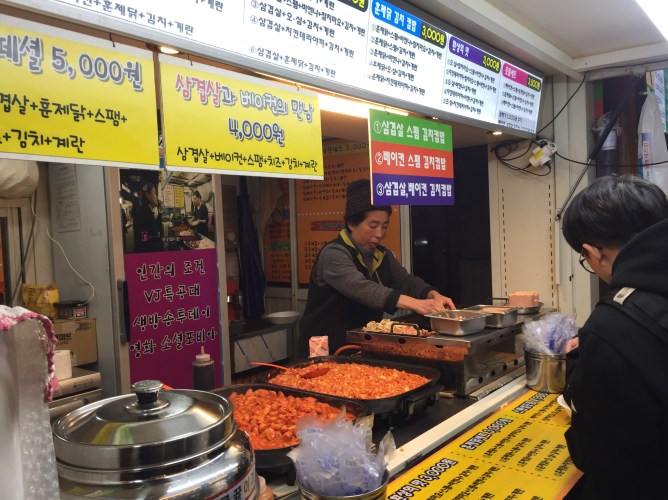
“Cup Bob” is a more than 20-year-old culture in Goshichon. A $3 rice bowl is one of most famous meal options for many hungry Goshichon’s residents, many of who don’t have enough money to eat at a sit-in restaurant. Photo Credit: Sean Na
It was past 6 p.m. in Goshichon. A 200-meter stretch of “Cup Bob” street chains began to open up their tents.
“Cup Bob” has been feeding many hungry Goshichon’s residents for more than 20 years. It’s a fried rice bowl that contains mixed vegetables and various meats. It’s one of most famous meals in Goshichon because busy residents could finish up one bowl in less than 5 minutes at a cost of 3000 won, or $3.
Kim In-soo, 54, has been running a “Cup Bob” chain for over 10 years in Goshichon. For Kim, whoever come to his chain with 3000 won in their pockets are like his own kids. Sometimes, he gives out a free bowl of hot rice to some he’s known for years who can’t afford a 3000 won rice bowl, he said.
“It’s a pity how I have seen these many young people studying days and nights to be a civil servant,” Kim said.
“The blame may be on us, the older generation. Maybe we should’ve paved out a better society for them, our kids.”
BEHIND SEOUL is a series focused on telling stories behind the glittering, industrialized Seoul. It covers various social issues, such as economies, poverty, unemployment and so forth. Ordinary people whom Reporter Sean Na meets on the streets in Seoul are the major characters for this series.

 Journalism Blog By Sean Na