
CHEONGNYANGNI, SEOUL – The 2018 Korean Thanksgiving Day was on Sept. 24. It’s a long-waited season for many Korean grandparents – as they rarely get to see their adult sons and daughters swamped with their busy everyday life in one of most fast-pacing countries in the world.
Cheongnyangni station, a major train hub in South Korea, was packed with many families saying goodbye to one another after a warm family gathering in the late afternoon of the Thanksgiving Day.
But less than a mile away from these happy families, Hang Woo-bun – who was sitting alone on a wooden floor at a narrow, old market street outside the station – was fingering her scratched silver ring that she gifted herself many years ago.
“Don’t say anything to me,” 82-year-old Hang said, while wiping away some tears from her eyes.
It’s been more than a half century since she spent a holiday season with her family.
Forcibly moved to Seoul while South Korea was suffering a long period of famine in the early ’60s, Hang said any holiday season for her is same old:
No buddies. No families. Just her alone.
In Seoul, more than 300,000 elderly, like Hang, live alone. That number represents more than half of the population over 65 in the city, which’s recently earned the top 15 happiest city in the world title in 2018 by Arcadis, a global consultancy firm.
To live an ordinary life in Seoul, one-person households need to earn at least 617,281 won ($547) a month. But many of these 300,000 elderly are dependent on the 250,000 won ($220) social pension for living and don’t hold a job that pays them above the Seoul’s monthly minimum cost of living.
“The biggest difficulties of most lone elderly people are poverty, illness and loneliness,” said Lee Noo-ri, who works at the Comprehensive Support Center for the Elderly Living Alone, a government-supported nonprofit.
Lee said the lone elderly population has rapidly increased partly because adult sons and daughters are feeling less responsibility of having to support their old parents.
And the result has brought a more than double-increased lone elderly population in Seoul since 2006, according to a data by the Seoul Metropolitan Government.
“An issue involving growing lone elderly population isn’t an individual issue anymore,” Lee said. “It’s rather a societal issue that needs all of us attention and care.”
On the day of the Korean Thanksgiving, Reporter Sean Na spoke with three lone elderly, including Hang, to learn about their lives and to simply be their talking buddy.
‘I just want to die nicely’

Kim Chang-soon, 86, sells dried-food near the Cheongnyangni station on Sept. 24, 2018. She said she wished she had someone to take care of her funeral, if she dies unexpectedly. Photo Credit: Sean Na
Kim Chang-soon, 86-year-old widow, runs a dried-food street vendor at one corner of an intersection outside the station, every day, from 10 a.m. to 8 p.m., to bring hopefully some money home by end of each day – so that she could continue to take care of her son with disabilities.
The nation’s largest holiday didn’t excuse her from running the vendor to bring as much as 50,000 won ($44) home, though if extracted the money spent on buying dried-food to sell, the profit margin isn’t much.
“I’ve been selling dried-food since the late ’60s right here, every day,” Kim said. “I am too old to do other things to bring more money home.”
Forty nine years ago, her husband died due to an injury he had while attending a compulsory Korean reserve forces training. At the time, Kim was 37 with no job and had two teenage sons to take care of, with the younger son born with disabilities.
The government gave her 300,000 won ($264) in compensation for the death of her husband. That money was just enough to sending her two sons up to middle school and starting the vendor.
Traditionally, on the morning of Korean Thanksgiving, Korean families prepare a holiday meal together to worship their ancestors, called Charye.
But for Kim, holding a family Charye has long been a someone else’s story – as her older son hasn’t come to see her for years because of his busy life, and her younger, 62-year-old son has to go to hospital every morning to inject a blood into his body to keep him alive.
Despite an uneasy life she’s lived for a half century, she however thanked the government for giving her the 250,000 won social pension every month.
“I really thank the government for the money I receive every month,” Kim said. “And I also thank God for giving me a good health to keep running this street vendor for many years.”
When asked what is her biggest hope for rest of life, she said:
“My hope is… I am badly feared…who would take care of my funeral, if I die unexpectedly?
“I just want to die nicely.”
‘It’s difficult to live alone’
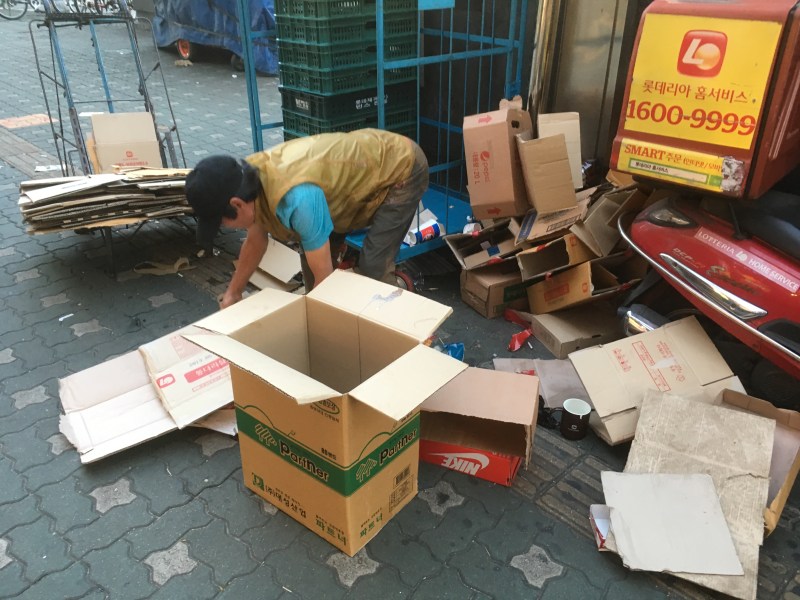
Kwon Hak-su, 65, picks up waste boxes on a busy street outside the Cheongnyangni station on Sept. 24, 2018. He said collecting 1kg of waste boxes gives him 50 won, or four cents. Photo Credit: Sean Na
Kwon Hak-su, 65, said he has a regular job: a waste picker.
For three years now, Kwon’s been picking up waste boxes thrown on the streets outside the Cheongnyangni station not to make money but to serve the people.
“By cleaning the streets, people can enjoy clean streets,” Kwon said. “Also, street cleaners from the government don’t work during the holidays. So I have to come here and pick up the wastes on behalf of them.”
Kwon divorced a wife several decades ago. He has two daughters, but they haven’t come to see him for 15 years now.
“My family are all separated,” Kwon said. “I live alone. It’s difficult to live alone nowadays.”
Collecting 1kg of waste boxes gives him 50 won, or four cents. But he said he doesn’t need much money because he lives alone.
In the past, selling 1kg of waste boxes yielded 30 won, but the price recently went up to 50 won, Kwon said.
It was past 6 p.m. when Reporter Sean Na met Kwon. After about 20 minutes talking to him, he walked his way dragging a wagon full of waste boxes, while leaving an important note.
“Well, I have to laboriously live my life,” he said.
‘Only heaven and earth know’

Hang Woo-bun, 82, walks along an alley near the Cheongnyangni station after rejecting to further speak with Reporter Sean Na on Sept. 24, 2018. Deserted by her family more than a half century ago, she never married anyone and has lived alone since then. Photo Credit: Sean Na
Hang seemed to have a story that she couldn’t tell anyone, because it was too hurtful for her to share.
“I am lonely,” Hang said. “I have endured a lot of hardships in my life.”
Despite repetitive requests, she said she can’t share her story.
“Only heaven and earth know how rough life I have lived so far,” she said, while heading to her single-room home.
BEHIND SEOUL is a series focused on telling stories behind the glittering, industrialized Seoul. It covers various social issues, such as economies, poverty, unemployment and so forth. Ordinary people whom Reporter Sean Na meets on the streets in Seoul are the major characters for this series.

 Journalism Blog By Sean Na
Hi Sean, I am glad to know some social phenomenon of South Korea. And I have to say we have the same problems in China, too. (Even worse) Because of the One Child Policy, many people are the only child of the family, buy we have both mom and dad, and we need to work 7-8h a day no matter women or men. So if our parents get to ill, what can we do? If we stop from work, we may worry about the money(the medical security is not reliable if somebody badly ill); if we continue to work, then who could take care of our parents? I read the stories about your interviewer and I suddenly realized that thousands of Chinese may in the same boat in the future.