
SEOUL, SOUTH KOREA — Thirty-two years ago, involuntarily laid-off Jeon Gun-seob rejected his older siblings’ offer to live in their house.
And, with an impaired left leg, he limped to the Seoul Train Station.
Since then, his everyday night job has been to find a seemingly warmest spot to sleep in- and outside the station, along with a hundred of others: homeless.
The homeless tittle, however, isn’t an accurate description of him. Rather, he is called “food angel” by his neighbors.
Almost every day, from morning to late afternoon, Jeon limps around the Seoul Station to collect free food from various volunteer groups. And when the sun goes down, he starts giving them away.
The 32-year veteran homeless man said he couldn’t eat any food that contains flour due to a personal health issue. But he said he still feels obliged to collect as many free food as possible so that he can help others in a worse situation than he is.
“My deepest regret is that I didn’t help those in need when I was healthy,” he said. “And I finally realize that at this old age of 62.”
The Seoul Station, especially since the 1997 Asian Debt Crisis that forced hundreds of Korean workers to be laid off, has been a home away from home for many Korean homeless people, like Jeon.
Since 2010, the homeless population in Seoul has steadily decreased from 4,340 in 2010 to 2,726 in 2017, according to a most recent data by the Seoul Metropolitan Government.
And in February 2018, the government initiated a job support program that would offer government-sponsored job opportunities up to 2,700 homeless people.
However, about a year later since the program was implemented, there were still a notable number of homeless men unreached by the program left on the streets, begging for pennies, in Seoul.
It was past 8 p.m., on the 2018 Christmas Day, around the station, when Reporter Sean Na met and mingled with Jeon and two other homeless men to learn about their rough life stories.
‘I just want to live without pain’

Moon Young-jae, 74, talks to Reporter Sean Na inside the Seoul Train Station on Dec. 25, 2018. Moon married a wife 44 years ago, but his parents forced him to divorce his wife — who suffered a liver disease and couldn’t bear a child — after three months in marriage. Photo Credit: Sol Lee
Moon Young-jae married a wife when he was 30. His wife suffered a liver disease and couldn’t bear a child. He wanted to keep his marriage, despite her infertility. But his parents didn’t agree and forced him to divorce her after three months in marriage.
That was 44 years ago. Since then, he never met his wife nor his parents because of a personal reason he rather not shares.
“I have no family,” he said. “And I am not sure whether my wife is dead or alive.”
He said he used to catch shrimps, work in a waterproof business and swipe floors. But after being forcibly laid off during the Asian Debt Crisis, he tried to get whatever job so that he could afford to pay a monthly rent for single-room home. But no places were willing to hire him.
And now 74-year-old Moon, for about 20 years, has been a homeless.
When asked about what may be his Christmas wish, he said:
“Well, I am well over 70 now. How can I have a wish then? I just want to live without pain.”
‘What am I living for? Nothing’
Kim Suk-man, 60, with his both legs visibly swollen, has been a homeless for 40 years.
He said his father is an elder at a local church, and his brother works as a producer for the Korean Broadcasting System, the largest broadcast media in South Korea.
But they never came to help him.
“My brother never helped me, and my father is at home,” Kim said. “And I am living on the streets, alone.”
Many years ago, he earned a forklift license hoping he could construct an ordinary life for himself. However, shortly after earning the license, his both legs started swelling up for a reason he hasn’t found out yet.
And he wasn’t able to get a paying job since.
“It’s unbearable,” he said.
When asked about what may be his Christmas wish, Kim stayed mute for a minute, started weeping and said:
“It’s too hard … I often think about my mom (who passed away two years ago) while crying … It’s too much for me.
“What am I living for? Nothing”
‘I pray I could live rest of my life without hurting people’
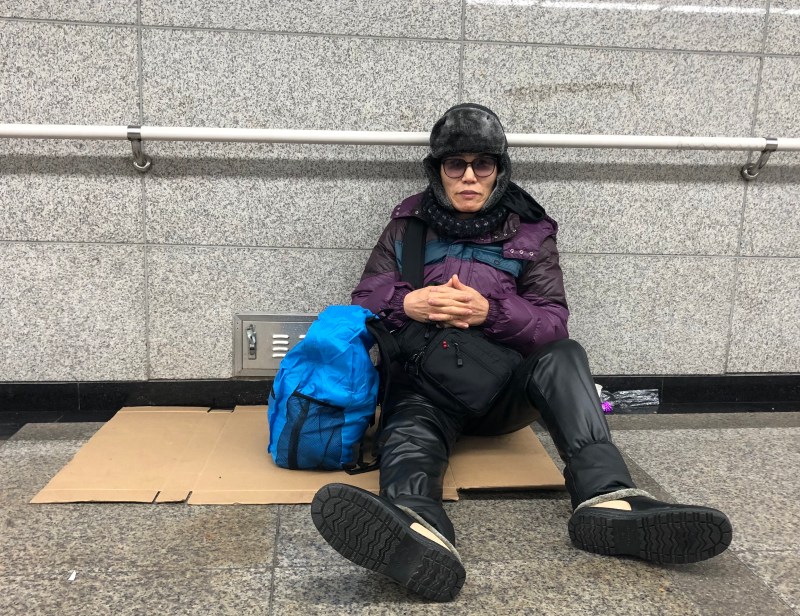
Jeon Gun-seob, 62, poses for a photo inside the Seoul Train Station on Dec. 25, 2018. Photo Credit: Sol Lee
Jeon was 29 sewing full-time at a clothing factory — when arthritis hit his left knee and engulfed his entire life.
Few days after he was diagnosed with arthritis, the factory fired him. He tried to work at other factories. However, those factories didn’t welcome an employee with disabilities.
“I got laid off few weeks later at most places I worked because of my disabilities,” he said.
His mother wanted to cure his left knee, carrying him in a wagon to every oriental medical clinic that she heard could cure his arthritis. But she couldn’t afford the treatment cost and never saw her baby son standing straight up again: She passed away a year after.
Her death devastated Jeon. He said he was so devastated that he attempted to end his life by drinking a bottle of thinner. But thankfully his attempt failed.
His two older siblings told Jeon that they would take care of him for rest of his life, but he rejected their hospitality.
“I didn’t want to get any sympathies from my brother and sister,” he said. “I really wanted to live on my own, without having to beg for help.”
Since then, for 32 years, the Seoul Station’s been his bedroom, a soup kitchen’s been his dinner, and a homeless church’s been where he prays every Sunday morning his only wish before ascending to a better world.
“I pray I could live rest of my life without hurting people and getting hurt,” Jeon said.
BEHIND SEOUL is a series focused on telling stories behind the glittering, industrialized Seoul. It covers various social issues, such as economies, poverty, unemployment and so forth. Ordinary people whom Reporter Sean Na meets on the streets in Seoul are the major characters for this series.

 Journalism Blog By Sean Na