
South Korea —
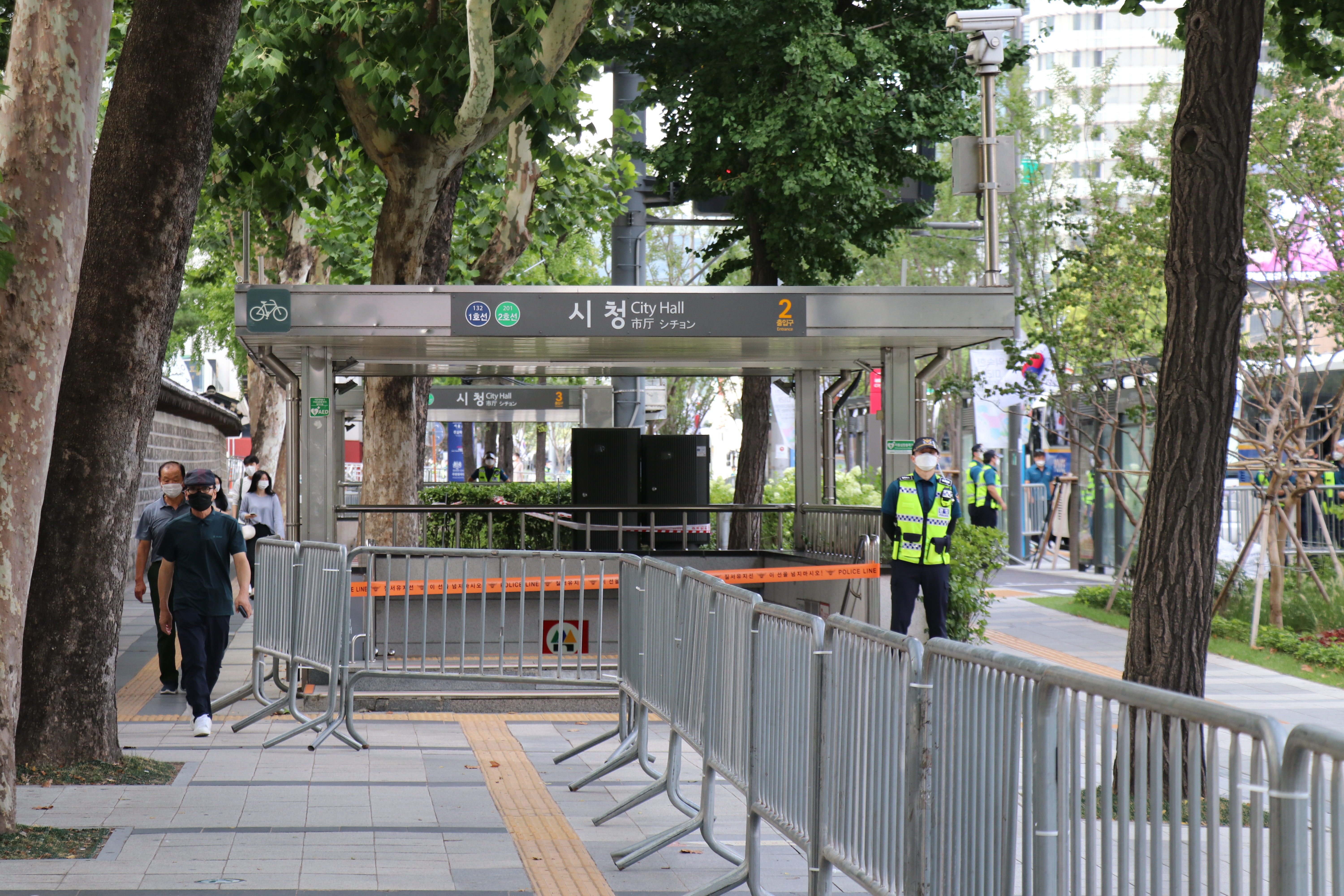
Galvanized steel barricades fenced in every street block in the central Seoul on Aug. 15 — the liberation day Koreans commemorate their ancestors’ bloody-earned freedom from Japanese authoritarian control during the world war era. Police queried every passerby why he or she must pass this block while checking belongings and IDs. Golden-agers swinging both Korean and American flags argued with police — that their democratic right to move freely was being confiscated. Police justified their authoritative move by citing laws designed after the 2009 swine flu pandemic to preempt a further spread of infectious diseases.
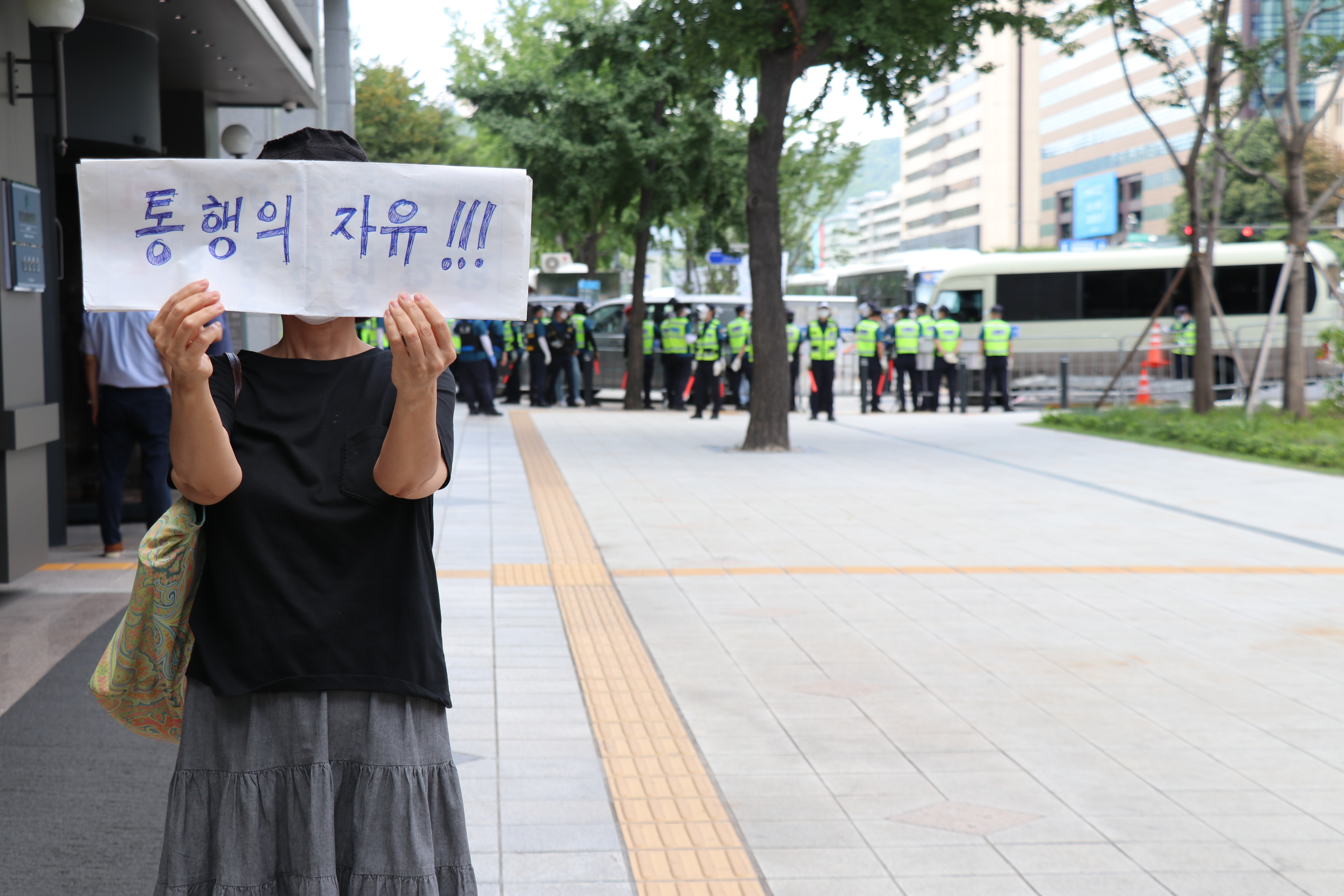
“Shouldn’t my right to move freely be protected?” said a visibly upset woman who nicknamed herself Lee Jin-ah holding a placard that read — “Freedom to pass” — on a street surrounded by police. “Nowhere but North Korea would block the entire streets where no protests are happening.”
Where 60-year-old Lee stood was a bystreet from the Gwanghwamun Square, a hub for non-violent, political protest for over a century in South Korea. At each major democratic milestone in the Korean Peninsula since 1919 was the square where Koreans amassed for peaceful protest. It was one of the key routes for the March First Independence Movement of 1919 that prompted the birth of Korean democracy; a battleground for the June Democracy Movement of 1987 that ended decades-long military dictatorship; and the frontline for 2016-17 Candlelight Demonstrations that brought millions of Koreans to the square to oust then President Park Geun-hye who let her civilian friend to maneuver the central government.
Once the bastion for Korean democracy, the square however was rather a place for government’s showcase to squelch what they called “illegal protests” poised to harm public health as the COVID-19 pandemic sniffed at once globally praised “K- Quarantine” model, threatened to collapse the country’s health system, and toppled a top 10 global economy by Gross Domestic Product in the second half of 2021.
Internationally recognized as one of the world’s most sturdy democracies as invited to the Group of Seven summit two years in a row, South Korea however contradicted one of the core democratic rights amidst the pandemic. A government’s mantra to protect lives in the name of the public health crisis restricted the right to peacefully protest for Koreans, raising a question on whether the government’s duty to protect lives should supersede a duty to protect civil rights.
Impaired democratic right in the name of COVID-19 pandemic
More than 4,900 public protests were prohibited by the government in 2021, according to the Korean National Police Agency. That’s over 600 increases from 2020, and a humongous jump from 2019 — when only nine protests were prohibited.
On Aug. 15, police buses barricaded the entire square. Most subway exits were closed to enable police to handpick any disguised protester. On the outskirts of the square were displaced elderlies gripping both Korean and American flags resting under the tree shades. Agitated by the tight-knit police control, some of them were live-streaming themselves on a mobile phone, grieving and crying foul.
The government’s rationale for the stringent control was to preempt the Aug. 15, 2020 déjà vu — when a mass anti-government protest led by a radical-conservative church at the square allegedly caused the daily count of coronavirus infections to soar from 50s to several hundred in weeks. Days after the anti-government protest, South Korean Prime Minister Kim Bu-gyeom explicitly called the church and protest organizers as “terrorist,” accusing that they used religion to shower chemical weapons at Koreans.
The church had announced a few days before Aug. 15, 2021 that it would hold another mass rally at the same place. The government promptly responded that it would exercise every measure to deter protests. As a result, no protest occurred inside the square on the 2021 Liberation Day. And, after the sunset, most police forces retreated.
Legal justification for stringent holdout on protests
Laws to legally ban protests during a public health crisis were drafted and passed after the 2009 Swine Flu pandemic. The laws say: “Citizens shall fully cooperate with the state or a local government in its policies to prevent the spread of quarantinable infectious diseases in the Republic of Korea,” and the government may “restrict or prohibit performances, assemblies, religious ceremonies, or any other large gathering of people.” Based on the laws, the Ministry of Health and Welfare banned any type of protest except a lone rally from mid-July to October 2021 — when the daily infections count was hovering well over 1500s.
Pandemic researchers were concerned about the lack of global standards on how to protect the civil liberties amid pandemic, noting human rights violations were exacerbated as each nation had to juggle through its existing laws to combat health crises. A study by California researchers argued no significant evidence was found to say public protests caused rapid increases in COVID-19 infections and-related hospitalizations — if all protestors wear masks and keep a proper social distance from one another.
Renee Kim, 24, was among many young adults whose weekend Seoul trip was spoiled due to the police control. “I was told (by police) where I was heading,” said Kim, who traveled 200 miles to Seoul to visit DeokSu Palace located on the south side of the square. “Then I was told I needed to take a detour.”
Lee Eun-soek, 21, with his girlfriend, had to make multiple detours to visit a local café. Until he arrived at the square, he hadn’t known there would be police barricading every street block, he said.
“I understand (why police are barricading the streets),” said Lee. “But it seems to me this is like a one-way notice where I have no say in it.”
Pandemic shifting to endemic, and peaceful protests remerge
The K-Quarantine fails. South Korea has recorded the greatest number of daily COVID-19 infections per capita in the world in March, according to the New York Times’ daily tracking system. The government have eased down on their COVID-19 restrictions, despite a soaring number of cases and concerns from health experts. The number of deaths, and those in intensive care unit have hit an all-time high in March, according to the health ministry.
On March 1, tens of thousands of protesters rallied at the Gwanghwamun square. All masked up, but they were hardly keeping a social distance from one another. Police were at the protest grounds but did not seize control like they did in August.
The Economist Intelligence report, which has annually measured the vigor of democracy of more than 160 countries since 2010, considered South Korea one of the 20 full-democracy countries, ranking it 16th among 167 nations in the Democracy Index 2021. However, when it comes to civil liberties, South Korea ranked 39th, tied with Namibia and Slovakia, both of which were considered a flawed democracy.
Lee Jin-ah said after lunch at a soybean noodle restaurant, she was scouting around for a public restroom. But at every street entrance were police telling her she couldn’t pass here.
“How on earth could people’s police block people’s liberty?” she said, while showing a food receipt to prove that she didn’t come to the square to protest.
BEHIND SEOUL is a series focused on telling stories behind the glittering, industrialized Seoul. It covers various social and political issues, such as economies, poverty, unemployment and so forth. Ordinary people whom Reporter Sean Na meets on the streets in Seoul are the major characters for this series.

 Journalism Blog By Sean Na